TODO: To change the footer's content go to Dr.Explain menu Options : Project Settings : HTML (CHM) Export : Setup HTML Template and Layout
Fixed wage versus hourly wage
CLOCK WORKERS: Employees clock for their hours in both cases.
The time programme is used in both cases to calculate the required hours/time due for the pay period (very important to set up the time programme correct).
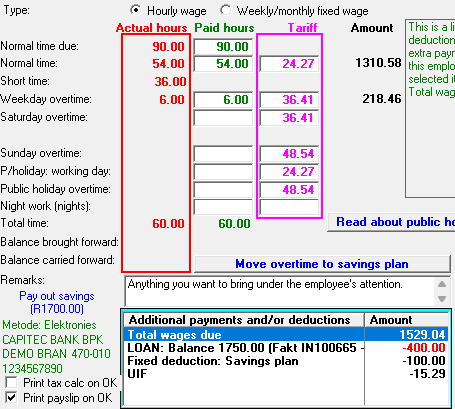
Hourly wage: Employees are remunerated exactly for the hours they've worked. The amount of short time and overtime is calculated by means of the time programme and balancing options.
1. Employees usually understand this method better, but in a short month the employee won't receive a lot of money and in a longer month the employee will receive more. The employees often struggle to meet all their financial obligations in a short month.
2. On this pay slip, the employee worked 54.00 hours within his/her required time. This is compensated at single rate. He/she worked overtime of 6.00 hours, compensated at time and a half. This will also depend on balancing of hours (overtime and short time).
Fixed wage: Employees receive a fixed wage if their required hours have been filled. The required hours is determined by the time programme. The system will see how many working days is in the pay period and the corresponding hours according to the time programme for that period.
1. If the employee worked less than the required hours, short time will be deducted from the fixed wage.
2. If the employee worked overtime, this will be added to the fixed wage.
With this method the employee has a more steady income because a month with 180 hours (e.g. February) and a month with 207 hours (e.g. October - depending on how the days fall) will result in the same compensation if the employee worked the required amount of hours.
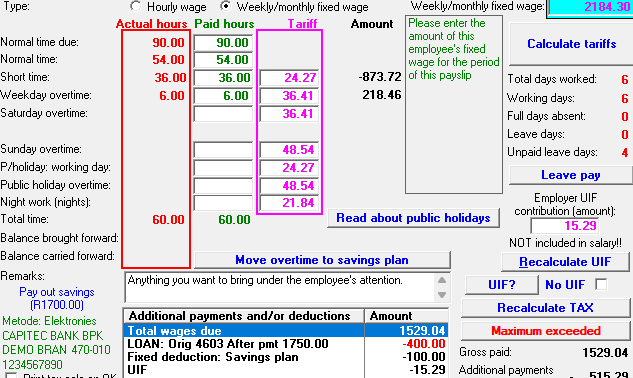
3. On the pay slip below, the employee worked the same amount of hours as the pay slip above but the wages are calculated using a fixed wage. In this case the hourly wage and fixed wage works out exactly the same. This will not always be the case. Some months it will be slightly more and some months it will be slightly less. This employee receive a fixed wage of R2184.30 for a two week period. The hourly tariff is exactly the same as the pay slip above. The employee worked 36 hours short which is deducted from the wage. Overtime is added (in this example, overtime and short time isn't balanced)
Clients often ask what is the correct/better method to compensate employees; hourly or fixed wage? Over a period of a year, the employee will basically earn the same, the one method gives a more steady income, where the other method pays the workers purely by the hour.
SALARIED WORKERS: Employees do not clock for their hours.
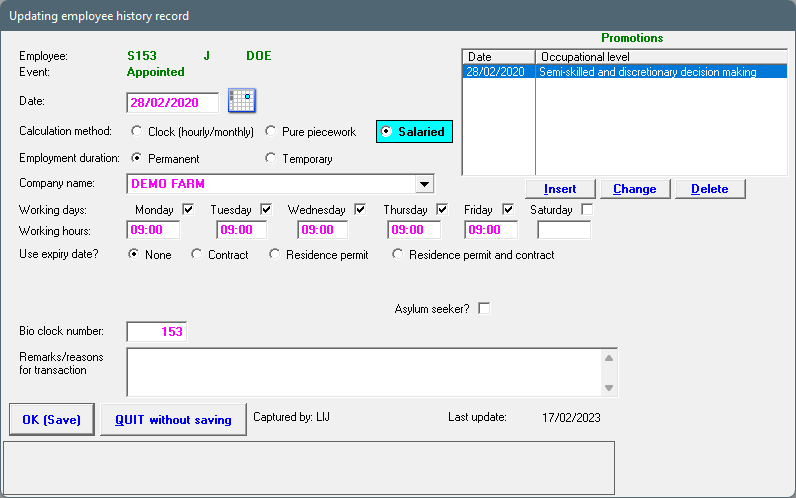
Hourly wage: The system calculates how many hours is in the pay period (the employee's hours are specified under employment history: Fix employee/Employment history)
The system will take the amount of days in the pay period and multiply it with the hours of each applicable day. The amount of hours will then be multiplied by the employee's hourly wage to calculate his wage for the period. Exceptions can also be used to import hours for salaried workers.
Fixed wage: The system uses the defined wage on each pay slip, regardless of the period. Unpaid leave will deduct hours of the defined wage. The user can add/deduct hours on the pay slip or by using exceptions.